


What Should a Cincinnati Hyundai Owner Check Before the First Hard Freeze?
Five things decide how a Hyundai handles its first hard freeze: the battery, the tires, the coolant, the wipers and washer fluid, and whatever is (or isn’t) packed in the cargo area. Checking all five now, while the afternoons are still mild, is the simplest Hyundai winter prep a Cincinnati driver can do. Most of it takes minutes, and the parts that need a technician are far easier to schedule in November than on the first frozen morning, when everyone else calls at once.
Why November Is the Right Month to Get Ahead of the Cold
Southwest Ohio rarely flips straight into winter. It drifts there, one colder morning at a time, which makes it easy to keep putting things off. The catch is that cold weather does not create most winter breakdowns; it exposes weaknesses that were already there. A battery that is three or four years old, tires worn close to the limit, or a coolant mix that has drifted out of balance can all feel fine in October and quit on the first morning that drops well below freezing. Fog in the river valley, wet leaves on the hills and darker evening commutes are already asking more of every car on I-275, so this is the window to catch problems on your schedule instead of the weather’s.
Have the Battery Tested Before a Cold Start Tests It for You
Cold weather slows the chemical reaction inside a 12-volt battery, so it delivers less starting power just when a cold engine needs more. That is why so many no-start calls arrive on the first frigid morning of the season. A quick load test shows whether a battery still has the reserve to handle it, and it takes a technician only a few minutes. While the hood is up, look for white or green corrosion on the terminals and make sure the clamps are snug. Hybrid Hyundai models still rely on a 12-volt battery to power up their systems, so they deserve the same check.
Tire Pressure and Tread: What Cold Air Does to Your Grip
Tire pressure drops as the temperature falls, roughly one psi for every 10 degrees, which is why the tire-pressure light so often comes on after the first cold night. Check pressures when the tires are cold and set them to the figures on the placard inside the driver’s door jamb, not the maximum printed on the sidewall. Then check the tread. Slide a penny into a groove with Lincoln’s head pointing down; if you can see the top of his head, the tread is at or below 2/32 of an inch and the tire is due for replacement. Worn tires that feel fine on dry pavement lose a lot of their grip on wet leaves, slush and icy ramps.
Coolant Protects the Engine From Freezing, Not Just Overheating
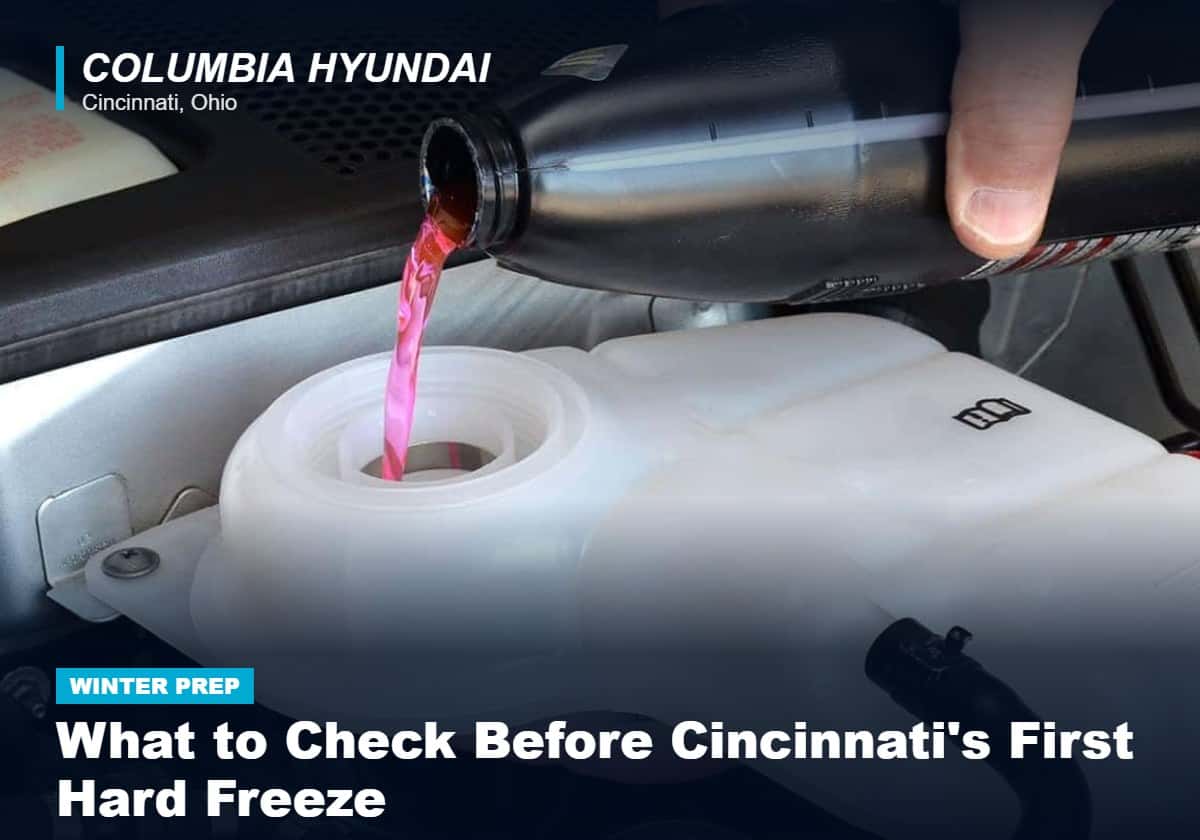
Engine coolant does two jobs. In summer it carries heat away from the engine, and in winter the antifreeze in the mix keeps the liquid from freezing inside the engine block and radiator. Over time that protection weakens, and topping off with plain water dilutes it further. A technician can test the mixture’s freeze protection in seconds and tell you whether it needs a top-off with the correct coolant or a full service. Check the overflow reservoir yourself only when the engine is cold, and never open a hot cooling system.
Wipers, Washer Fluid and a Clear Windshield
Visibility is the part of winter driving most people underestimate. Summer heat dries out wiper rubber, and blades that streak in the rain will smear salt spray across the glass once the road crews start treating the highways. Replacing them is inexpensive and takes minutes. Swap the washer reservoir over to a winter-rated fluid as well, since ordinary fluid can freeze in the lines and the nozzles. If your Hyundai has heated mirrors or a heated wiper area, test them now so you know they work before the first frosty commute.
A Small Winter Kit That Earns Its Space in the Cargo Area
A few items in the cargo area turn a stalled car or a long backup into an inconvenience rather than an emergency: an ice scraper and snow brush, a blanket, gloves, a phone charging cable, a flashlight, jumper cables or a portable jump starter, and a bottle of water. Add a bag of sand or kitty litter if you park on one of the steeper streets around the city, since it gives a spinning tire something to bite on. With Thanksgiving travel on I-71 and I-75 coming up, it is worth packing before the first long drive.
Which Hyundai Winter Prep Items Belong on Your Service Visit
Some of this list is driveway work and some of it is not. Tire pressure, wiper blades, washer fluid and the winter kit are easy to handle yourself. A battery load test, a coolant freeze-protection check, a close look at brake pads and rotors, and a tire inspection are better left to a technician who can do all of them in a single visit. Booking now means you pick the appointment time instead of competing for one on the first icy morning.
A little preparation now makes the first cold snap a non-event. The service team at Columbia Hyundai in Cincinnati can test your battery, check your coolant and inspect your tires in one stop, and the parts department stocks the wiper blades and winter fluids to finish the job.
Schedule Your Winter Service Visit
For Hyundai owners across the Cincinnati area, one visit to Columbia Hyundai’s service drive covers the battery, coolant and tire checks before the first hard freeze arrives.
Disclaimer: The content provided in this article is intended for informational purposes only. Vehicle images may not depict the exact model, trim, features, packages, accessories, or specifications described. Vehicle pricing, availability, features, and specifications are subject to change without notice. Please consult the dealership directly for complete and accurate vehicle information.
0 comment(s) so far on What Should a Cincinnati Hyundai Owner Check Before the First Hard Freeze?